From Theory to Practice with Talking Across Difference: Where Democracy Actually Happens
Written by Janina Walburg, Spring 2026 TAD Student Leader
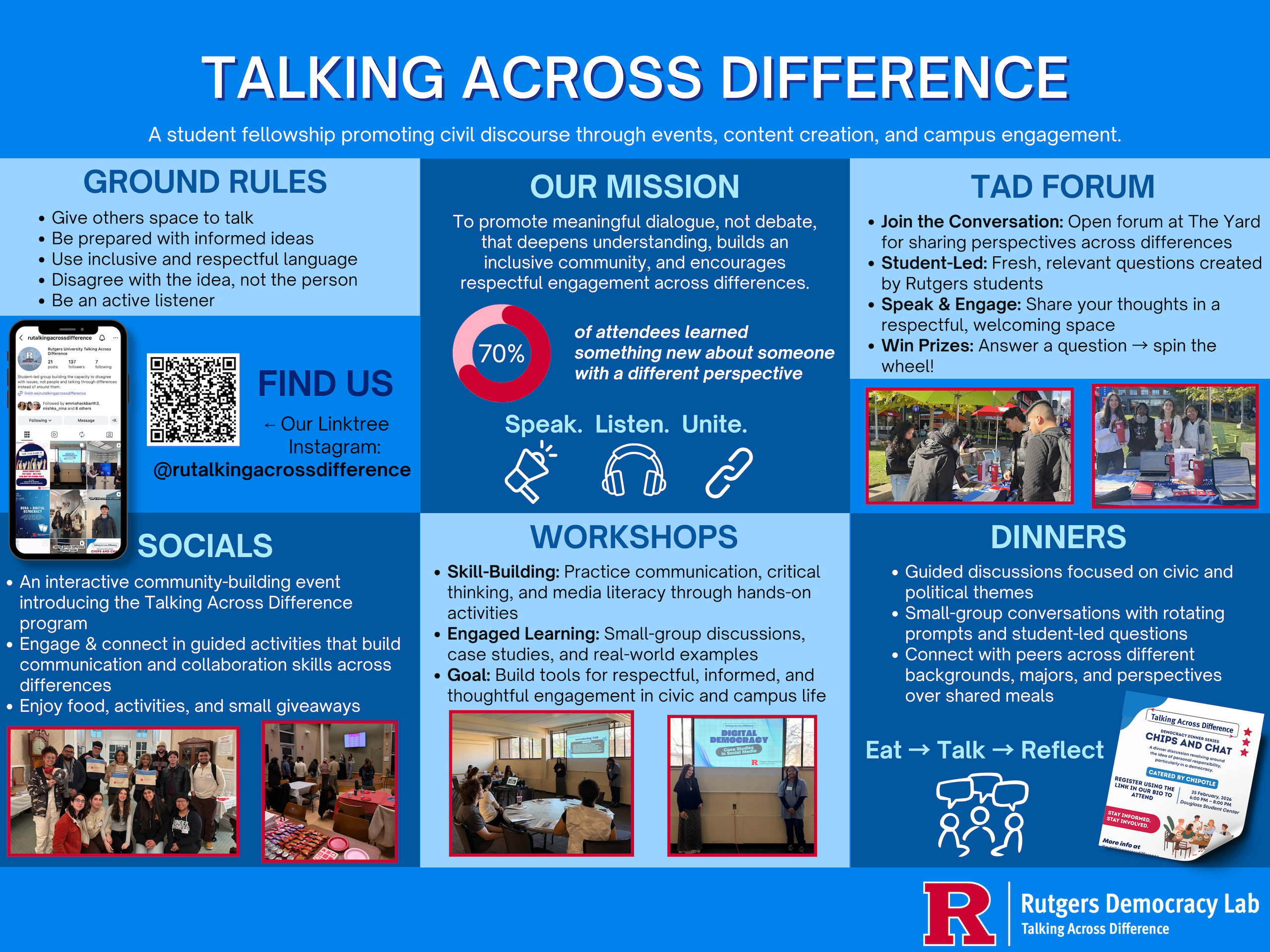
Presenting Talking Across Difference at the Rutgers Democracy Lab Showcase forced me to confront a simple but often overlooked question: where does democracy actually happen? Spoiler alert: it happens everywhere!
Whenever I asked that question to students passing by the poster, they tended to think of democracy in formal institutions, such as elections, legislatures, courts, etc. But what became clear through both my work and the reactions at the showcase is that democracy is just as dependent on the quality of everyday interactions between individuals. If those interactions break down, so does the system that rests on top of them.
Talking Across Difference (TAD) is built around this premise. It is not designed to produce agreement, nor is it a space for debate in the traditional sense. Instead, it creates structured environments where participants can engage across political and social differences with an emphasis on listening, reflection, and intellectual humility. The goal is not to “win” an argument, but to better understand how and why others think the way they do and, in the process, to interrogate one’s own assumptions.
At the showcase, I presented this work alongside fellow TAD members, and what stood out immediately was how intuitive yet unfamiliar the model felt to many attendees. People are accustomed to conversations about politics being fast, reactive, and often adversarial. I often got the question, “How do I win?” TAD disrupts this idea of winning by slowing the conversation down and we get to “win” as a society when we are able to talk to one another.
During the showcase, this dynamic became especially visible through participant reactions. After engaging in dialogue, several students expressed a desire for more time and more space to continue the conversation, to ask follow-up questions, to sit with perspectives they had not previously considered. This deeply intrigued me as I realized that the issue is not a lack of interest; it is a lack of accessible, well-designed spaces for engagement.
In that sense, TAD reveals something important about democratic participation: when the conditions are right, people are willing, eager even, to engage. But those conditions do not emerge on their own. They must be intentionally created, facilitated, and sustained. If democracy is, at its core, a system that depends on collective decision-making among diverse individuals, then the ability to communicate across difference is not optional, but foundational.
And that is exactly what Talking Across Difference is trying to build.